Conclusion

Who was the antagonist?

My interpretation of Lady Macbeth and Macbeth is that they occupy the same role in Macbeth, antagonist. However, this position is not held simultaneously, rather it begins to switch in Act Two and completely by 3. Early on Lady Macbeth is prodding her husband to kill Duncan and convinces him in a show of dominance (I. VII. 60-71). After slaying Ban quo/Duncan she figuratively disappears and Macbeth claims her emptied mantle, which we later learn is from guilt (V. I, 49-51). Therefore, from a certain perspective they are one figure, who has great ambition and a propensity towards violence.

Most Stomach Churning Moments?

I do not like the defiling of Human corpses this includes death by bisection as seen in Act One. So for me (I. II, 22-23) and (V, VIII. page 3) are the most vile moments in Macbeth because they include the aforementioned.

Final thoughts.

I have read a few of William Shakespeare’s works aside from Macbeth, including “Much Ado About Nothing”, “Romeo and Juliet”. “Hamlet”, etc. Out of them all the one I enjoyed most, was by far Macbeth, because it had a more intriguing background, riveting scenery and impressive main character. As a fan of history the fact that Macbeth was a real person instantly draw me into the storyline. I not only read Macbeth but looked into the real person and enjoyed both. Scotland has a beautiful landscape and seeing the land while scouring for pictures greatly enhanced my perception of the play. Macbeth is a very powerful individual who is seen cutting Macdonwald in two during the beginning. In addition he fights Macduff to the death even when given the option of survival, very impressive. Therefore, I liked Macbeth because I like history, Scottish highlands and strength/bravery.
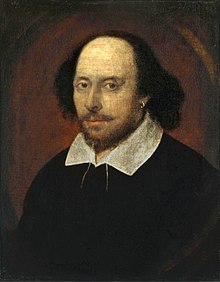
William Shakespeare, writer of many English Classics including Macbeth and a fitting end to a blog on one of his most known pieces. Fitting because by showing the author you can see who wrote the play and see he was like any other, very inspiring at least to me.

Act Five

In the beginning we learn of Lady Macbeth’s sleepwalking, a manifestation of her guilt which eventually leads to her suicide in scene five and Macbeth’s loss of humanity “She should have died hereafter. There would have been a time for such word” (V, V. 17-18). Simultaneously an English/Scottish army marches on Duns-inane and takes branches from Birnam woods to conceal their forces thus making it appear as though the woods were moving. This is important because Macbeth thought this impossible and his reign secure but now begins to understand his kingdom will fall, though still believes himself un-killable “Thou wast of woman. But swords I smile at, weapons laugh to scorn, Brandished by man that’s of woman born.” (V, VII. 13-15). Ultimately he is slain by Macduff who was birthed by a caesarian section and King Duncan’s son is instated as king.

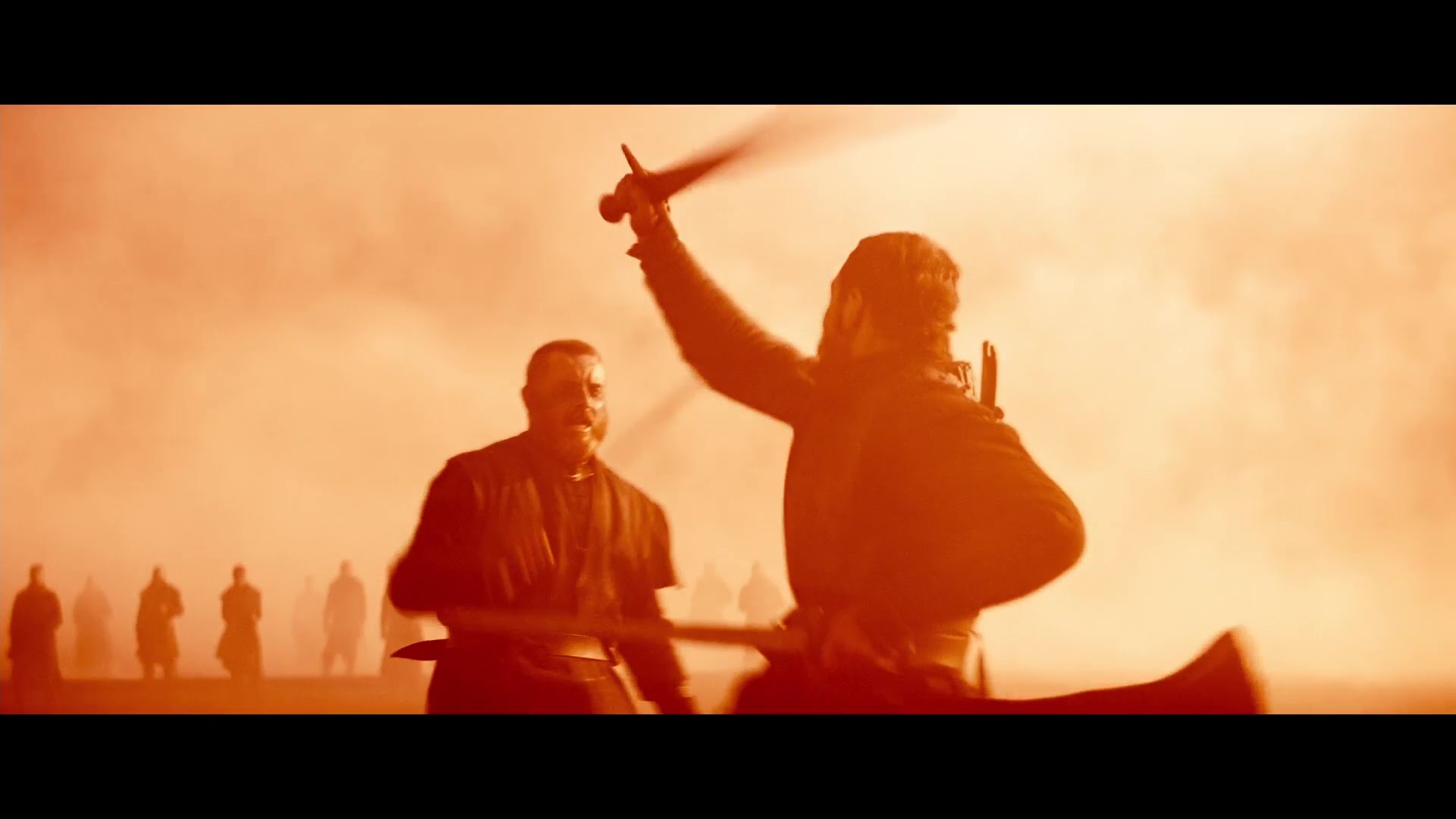
An image from a Macbeth film representing Macduff and Macbeth’s duel. I chose it because even though he knew the witches had tricked him by then he still fought bravely which is very admirable and really represent the titular characters strength.

All of the witches prophecies come true in Macbeth save one which is a nod to the British King at the time. For the people involved, whose lives were foretold it brings into question, fate or freewill. I believe that fate is the actions carried out while free will is the understanding of the decisions. This is supported in Macbeth by Malcolm moving the forest unaware of the witches existences, therefore, providing evidence what they saw was the inescapable future.

Act Four

Arguably the most violent act, Act Four sees Macbeth greeted by the witches once again with three new prophecies, be wary of Macduff who has fled to England, no one born from a women can harm Macbeth and defeat will only come when birnam woods moves. Angered by Macduff’s departure Macbeth’s change is complete he no longer needs a good reason to kill, he just does so out of desire “The castle of Macduff I will surprise, Seize upon Fife, give to th’ edge o’ th’ sword his wife, his babes, and all unfortunate souls That trace him in his line. No boasting like a fool.” (IV, I. 156-159).

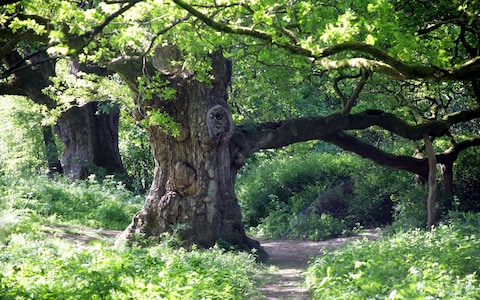
The only tree in Birnam woods that has been around since Shakespeare’s time, an obvious choice because the predictions are one of the most important parts of Act Four and among them trees moving certainly the most interesting.

Violence has made Macbeth not only cruel but reckless, were he would once think carefully he know charges blindly because of simple riddles offered by the strange. This is unfortunate because of how the prophecies are presented requires unraveling to make use of them. However, by this point Macbeth did not bother to think beyond “Be bloody, bold, and resolute. Laugh to scorn The power of man, for none of woman born Shall harm Macbeth.” (IV, I. 81-84) and made his sealed fate obvious.

Act Three

Act 3 presents a change in the story with important figures assassinated and rebels preparing for war against Macbeth who has become tyrannical “Free from our feasts and banquets bloody knives” (III, VI. 35).

For me Act Three is one of the saddest because it kills off Ban quo, a favored character of mine. Therefore, while not a change I would have liked a sequel of the intro, or at least expansion, detailing the civil war mentioned in Act One.

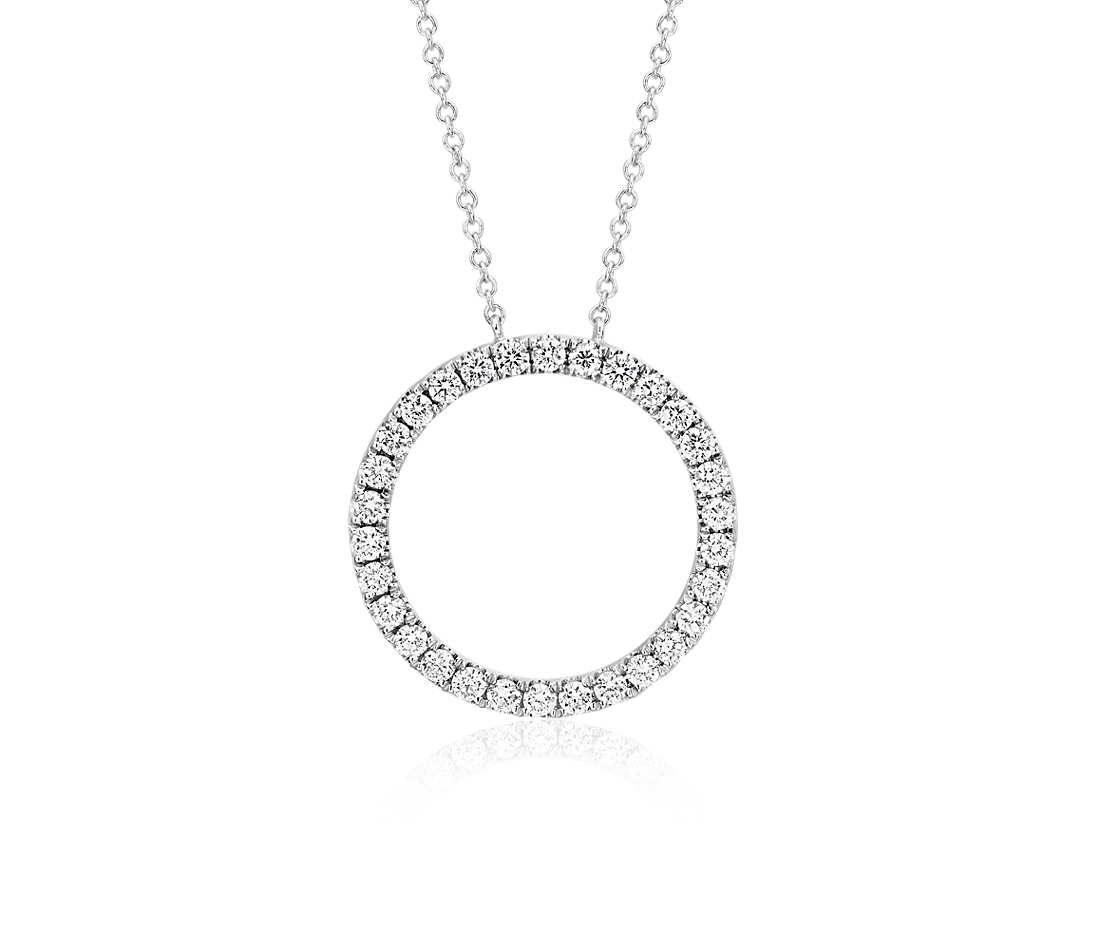
The circle symbolizes how Macbeth is trapped in a deadly cycle, in which he must turn to violence for survival, yet this only worsens his situation. In my mind Macbeth is a pawn of the witches so having his cycle bound by chains to an unseen force/object represents his ultimate lack of power.

I believe in Act Three you begin to see how inescapable the witches prophecy is, specifically by the inability of Ban quo’s line from being snuffed out and shaping of a rebellion by outcasts “Hath so exasperated the king that he Prepares for some attempt of war” (III, VI. 37).

Act Two

In Act Two the respected Macbeth, spurred by the witches prophecy steels his resolve to usurp the throne “I go, and it is done.” (II, I. 62). By the end Duncan is dead and the blame laid upon drunken guards framed by the conspiring Macbeth’s.

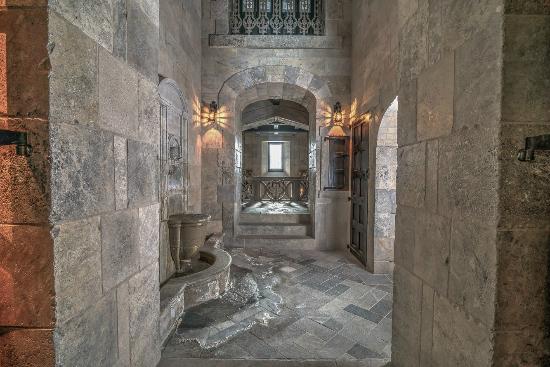
My interpretation of Macbeth’s castle in Inverness where King Duncan was slain (Though the real Macbeth lived centuries before the Cawdor Castle was built, in Shakespeare’s time this probably where it was set but I could not find any interior photos).

Destiny is beginning to unfold with a vacancy for King being left and few as fit to rule like Macbeth.

Act One

Macbeth opens up with a meeting of witches in dire weather, conspiring surely to do evil. We then are introduced to many important characters (King Duncan, Ban quo, Etc) including the titular Macbeth during a post civil war discussion. Here Macbeth disposition and capability for violence are revealed and ambitions “Till he unseamed him from the nave to th’ chops, And fixed his head upon our battlements” (I, II. 22-23) “If chance will have me king, why, chance may crown me Without my stir.” (I, III. 147-148).


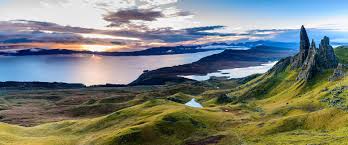
I chose a beautiful photo of the Outer Hebrides because they are mentioned in Act One and allow one to understand the setting.

The concept of fate in Macbeth is evidenced by the prophetic witches and introduced in Act One were they tell Macbeth he will be king and Ban quo’s children kings.